 By AdmissionGuru
 Medical Education
Study Medicine Abroad Cheapest Countries for MBBS in 2025
Achieve your dream of becoming a doctor without drowning in debt by exploring affordable international medical programs.
Published: December 24, 2025
By:Sarah Johnson
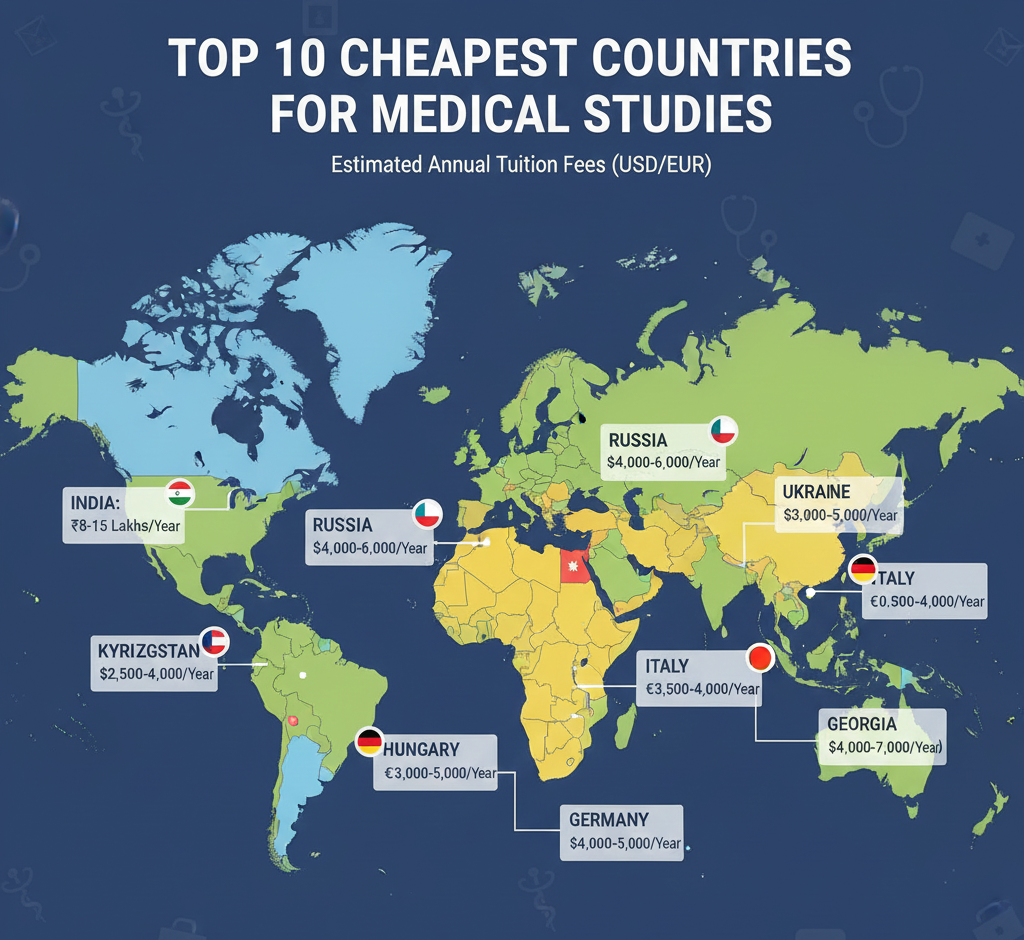
Becoming a doctor shouldn’t require drowning in debt. For thousands of aspiring medical students, the dream of earning an MBBS degree feels financially impossible when tuition at private medical colleges can exceed $60,000 per year. Here’s the good news: you can study medicine at internationally recognized universities for as little as $1,750 annually. Countries like Russia, Kyrgyzstan, China, and the Philippines offer world-class medical education without the crushing financial burden. This comprehensive guide explores the cheapest countries to study medicine abroad in 2025, covering tuition costs, living expenses, admission requirements, and everything you need to make an informed decision about your medical career.
Why Consider Studying Medicine Abroad?
Before we explore specific countries, let’s address why studying MBBS abroad has become increasingly popular among international students, particularly from India, Africa, and Asia.
Medical education costs have skyrocketed in many countries. In the United States, medical school tuition averages over $60,000 per year. Private medical colleges in India can charge similar amounts, with limited seats available. This financial reality has pushed talented students to look beyond their borders.
Key Takeaway
-
✅
Studying medicine abroad isn’t just about saving money—it’s about accessing quality education, gaining international exposure, and building a global medical career without overwhelming debt.
The benefits extend beyond affordability. You’ll experience different healthcare systems, interact with diverse patient populations, and earn degrees recognized by major international bodies like the World Health Organization (WHO) and the World Federation for Medical Education (WFME). For Indian students, many universities are recognized by the National Medical Commission (NMC), allowing you to practice medicine in India after clearing the required licensing exams.
Understanding the True Cost of Studying Medicine Abroad
When evaluating the cheapest countries for MBBS, you need to look beyond tuition fees alone. The complete financial picture includes several components that will affect your total investment.
Tuition fees vary dramatically by country and institution. You’ll find annual costs ranging from $1,750 in Russia to around $16,000 in Hungary. Living expenses matter equally—accommodation, food, transportation, and personal expenses can add $2,400 to $8,400 annually depending on your location.
Don’t forget about one-time costs: visa application fees, travel expenses, medical insurance, and document verification can add $1,000 to $3,000 to your first-year expenses. Course materials and clinical training equipment may require additional investment.
💡
Pro Tip
Calculate the total 6-year cost (including living expenses) rather than just annual tuition when comparing countries. A country with slightly higher tuition but much lower living costs might actually be more affordable overall.
Top 10 Cheapest Countries to Study Medicine Abroad
Based on 2025 data, here are the most affordable destinations for international medical students seeking quality education without breaking the bank.
Russia: The Budget-Friendly Medical Education Leader
Russia has established itself as the top choice for affordable medical education, particularly for Indian students seeking quality programs at minimal cost.
Annual tuition fees in Russia range from $1,750 to $8,000, making it one of the most economical options globally. The monthly cost of living averages between $200 and $400, covering accommodation in university hostels, meals, local transportation, and basic necessities.
Russian medical universities maintain high academic standards with degrees recognized internationally by WHO, NMC, and other major medical councils. The MBBS program (called MD in Russia) spans 6 years including theoretical study, practical training, and extensive clinical exposure.
Over 54 Russian medical universities are recognized by international medical bodies. Notable institutions include Pavlov First State Medical University, Saint Petersburg State Medical University, and Kazan Federal University. Most offer English-medium programs, though you’ll learn Russian language basics for patient communication during clinical rotations.
The country’s established medical education system dates back decades, with modern facilities and experienced faculty. You’ll complete your internship in Russia, though Indian students must complete an additional mandatory internship in India after clearing the licensing exam.
Kyrgyzstan: Emerging as a Top Affordable Destination
Kyrgyzstan has rapidly gained popularity among international students seeking the cheapest MBBS programs without compromising educational quality.
Tuition fees range from just $2,000 to $4,000 per year, among the lowest globally. Living expenses are remarkably affordable at $200 to $300 monthly, making Kyrgyzstan ideal for budget-conscious students.
All recognized medical universities in Kyrgyzstan offer English-medium instruction, eliminating language barriers. The curriculum follows international standards, and degrees are WHO-approved. Seven universities in Kyrgyzstan are recognized by the NMC for Indian students.
Clinical training begins early in the program with hands-on experience in affiliated hospitals. While classes are in English, you’ll receive Russian language training for patient interaction during clinical years, starting from the fourth year.
The MBBS course duration is 6 years, including a mandatory 12-month internship. Popular universities include Asian Medical Institute, Kyrgyz State Medical Academy, and International School of Medicine.
China: Advanced Infrastructure at Affordable Prices
China offers a compelling combination of cutting-edge medical technology, modern infrastructure, and competitive tuition rates that appeal to thousands of international students annually.
Annual tuition fees range from $2,600 to $7,000 depending on the university and city. Living costs average $300 to $500 per month, relatively low compared to Western countries.
Chinese medical universities boast state-of-the-art facilities with advanced medical equipment and extensive research opportunities. Many programs are taught entirely in English, though some universities require basic Mandarin proficiency for clinical interactions.
The MBBS program lasts approximately 5 years and 9 months plus a mandatory 1-year internship. China’s medical degrees are globally recognized and specifically approved by the NMC for Indian students.
Leading institutions include Peking University Health Science Center, Fudan University, Shanghai Jiao Tong University School of Medicine, and Zhejiang University. These universities consistently rank among Asia’s top medical schools.
Students benefit from substantial clinical exposure throughout their training, with opportunities to work in some of China’s largest and most advanced hospitals. The country’s rapid healthcare modernization means you’ll learn using the latest medical technologies.
Philippines: English-Medium Programs at Low Cost
The Philippines stands out as an ideal destination for students seeking English-taught medical programs in an environment culturally similar to Western education systems.
Tuition fees range from $4,000 to $8,000 annually. Living expenses are equally affordable at $300 to $600 monthly, including accommodation, food, and transportation.
All medical programs in the Philippines are conducted in English, eliminating any language barrier. The curriculum follows a structure similar to American medical education, making it an excellent pathway for students planning to take U.S. licensing exams (USMLE) in the future.
The medical program typically spans 4 years following a pre-medical course, or 5-6 years as an integrated program. Filipino medical schools emphasize clinical training with extensive hospital rotations.
Degrees from recognized Philippine medical universities are accepted in India after clearing the FMGE/NExT exam, and graduates can also pursue opportunities in the United States, United Kingdom, Middle East, and other regions.
Major universities include University of Santo Tomas, University of the Philippines Manila, Far Eastern University, and Cebu Institute of Medicine.
Germany: World-Class Education with Minimal Tuition
Germany offers an unbeatable value proposition: world-renowned medical education at public universities with little to no tuition fees.
Most public medical universities in Germany charge no tuition fees, requiring only administrative fees of approximately $200 to $500 per semester. Private institutions may charge around $4,000 per year, still significantly lower than many countries.
Living expenses are moderate for Europe, averaging $800 to $1,000 monthly. This includes accommodation, food, health insurance (mandatory in Germany), and transportation.
⚠️
Important
While tuition may be free or very low, German medical programs are highly competitive and typically taught in German. You’ll need to demonstrate German language proficiency (usually TestDaF or DSH certification) and meet strict academic requirements.
The medical education system in Germany is rigorous, spanning 6 years and combining theoretical knowledge with extensive practical training. German medical degrees are among the most respected globally.
Top medical universities include Ludwig Maximilian University of Munich, Heidelberg University, Charité – Universitätsmedizin Berlin, and University of Freiburg.
For students willing to learn German and meet high academic standards, Germany offers unparalleled quality at minimal cost.
Poland: European Quality at Affordable Rates
Poland has emerged as a popular European destination for medical students seeking quality education at reasonable prices.
Annual tuition fees range from $7,000 to $15,000, depending on the university. Living costs are affordable at $500 to $700 monthly, much lower than Western European countries.
Polish medical universities offer programs in English, making them accessible to international students. The education quality is high, with modern facilities and experienced faculty members.
The MBBS program duration is 6 years, including theoretical study, laboratory work, and clinical rotations. Degrees are recognized throughout the European Union and by major international medical councils including the NMC.
Leading institutions include the Medical University of Warsaw, Jagiellonian University Medical College, Medical University of Gdansk, and Wroclaw Medical University.
Poland’s location in the European Union provides additional benefits—graduates can practice medicine across EU countries after completing necessary licensing requirements, opening doors to career opportunities throughout Europe.
Belgium: Hidden Gem of European Medical Education
Belgium offers surprisingly affordable medical education, especially at public institutions, making it one of Europe’s best-kept secrets for budget-conscious medical students.
Public university tuition ranges from $2,000 to $3,000 annually, while private institutions charge approximately $4,800 per year. Living expenses average $800 to $1,000 monthly.
Belgian medical schools maintain high standards with comprehensive curricula covering all essential medical disciplines. Programs are available in Dutch, French, and some in English, depending on the region and university.
The medical degree program typically lasts 6 years. Belgium’s strategic location and membership in the European Union mean your degree is recognized across Europe.
Notable universities include KU Leuven, Ghent University, and Université catholique de Louvain. These institutions combine academic excellence with research opportunities.
Ukraine: Affordable Option with Important Considerations
Ukraine has traditionally been a popular destination for affordable medical education, though current circumstances require careful research.
Tuition fees range from $3,000 to $6,000 annually when programs are available. Living costs are among the lowest in Europe at $200 to $400 monthly.
⚠️
Important
Due to ongoing geopolitical situations, many Ukrainian universities have relocated programs or partnered with institutions in other countries. Always verify current program status, safety, and location before applying.
Ukrainian medical universities offer English-medium programs and are recognized by international medical bodies. The MBBS program is 6 years including internship.
Students must clear additional KROK-1 and KROK-2 exams (after 3rd and 6th years respectively) to receive their degree, with three attempts allowed.
Bangladesh: Proximity and Cultural Familiarity for Indian Students
Bangladesh offers an attractive option for Indian students due to geographical proximity, cultural similarities, and affordable education costs.
Annual tuition fees range from $3,000 to $8,000 depending on the institution. Living expenses are remarkably low at $200 to $400 monthly, making it one of the most budget-friendly options overall.
The close proximity to India means lower travel costs and easier family visits. Cultural and lifestyle similarities help international students adapt quickly.
Medical education in Bangladesh follows standards similar to India’s curriculum. The MBBS program is 5 years plus a 1-year internship. Degrees from recognized Bangladeshi universities are accepted by the NMC after passing required exams.
Major medical colleges are affiliated with seven main universities recognized by the NMC, including Dhaka University, Rajshahi University, and Chittagong University.
Hungary: Quality European Education
Hungary combines affordable tuition with high-quality European medical education, attracting students from around the world.
Annual tuition fees range from $6,000 to $16,900. While slightly higher than some options on this list, Hungary’s lower cost of living (approximately $500 to $700 monthly) and excellent education quality provide good overall value.
Hungarian medical universities offer English-language programs and are well-regarded internationally. The curriculum is rigorous and aligned with European standards.
The medical program spans 6 years. Degrees are recognized globally and throughout the European Union.
Prestigious institutions include Semmelweis University (one of Europe’s oldest medical schools), University of Debrecen, University of Pécs, and University of Szeged. These universities offer excellent research opportunities and modern facilities.
Essential Requirements for Studying Medicine Abroad
Understanding admission requirements helps you prepare your application effectively and increases your chances of acceptance.
Academic Requirements
Most countries require completion of 12th grade (or equivalent) with Physics, Chemistry, and Biology. Minimum marks typically range from 50% to 60% in these subjects, though requirements vary by country and university.
For Indian students, qualifying NEET (National Eligibility cum Entrance Test) is mandatory for admission to foreign medical universities. Your NEET score remains valid for three years from the date of result declaration.
Some countries or universities may require additional entrance exams or interviews as part of their admission process.
Language Proficiency
For English-medium programs, you’ll typically need to demonstrate English proficiency through IELTS (usually 6.0 or higher) or TOEFL scores. Some universities may exempt students from English-speaking countries or those who completed previous education in English.
For programs taught in other languages (German, Russian, Polish, etc.), you’ll need to demonstrate proficiency in that language or complete a preparatory language course before beginning medical studies.
💡
Pro Tip
Many universities in Russia, Ukraine, and Kyrgyzstan offer English-medium programs but include mandatory language courses for patient communication during clinical years. This isn’t an additional cost but is built into the curriculum.
Documents Required
Prepare these documents for your application: valid passport, academic transcripts and certificates from 10th and 12th grade, NEET scorecard (for Indian students), birth certificate, medical fitness certificate, police clearance certificate (no objection certificate), passport-sized photographs meeting specific requirements, and proof of financial capability.
Requirements may vary slightly by country and university, so always check specific institutional requirements when applying.
Age Criteria
Most countries require applicants to be at least 17 years old by December 31st of the admission year. Maximum age limits vary but typically range from 25 to 35 years.
Understanding Medical Degree Recognition and Licensing
Earning your medical degree abroad is just the first step. Understanding how to practice medicine in your home country or internationally is crucial for career planning.
For Indian Students: NMC Guidelines
The National Medical Commission (formerly Medical Council of India) has established clear guidelines for students studying MBBS abroad. Your chosen university must meet NMC requirements for your degree to be valid in India.
Key NMC requirements include: minimum course duration of 54 months (4.5 years) plus mandatory 12-month internship, the program must cover all essential medical subjects (General Medicine, Community Medicine, Psychiatry, Pediatrics, Surgery, Obstetrics and Gynecology, Ophthalmology, etc.), the entire course and internship must be completed at the same institution, medium of instruction must be English, and the university should be established for at least 10 years.
The NMC does not maintain a specific list of approved universities. Instead, universities must meet the above criteria and be recognized by the World Health Organization.
Licensing Exams
To practice medicine in India after completing MBBS abroad, you must: pass the Foreign Medical Graduate Examination (FMGE) or National Exit Test (NExT), which is being introduced to replace FMGE. The NExT exam is scheduled to become mandatory from 2025 onwards.
After passing the licensing exam, you must complete an additional 12-month internship at an NMC-recognized hospital in India before receiving your license to practice.
International Recognition
Most universities in the countries listed are recognized by: World Health Organization (WHO), World Federation for Medical Education (WFME), Educational Commission for Foreign Medical Graduates (ECFMG) for those planning to practice in the United States, and General Medical Council (GMC) for the United Kingdom.
Always verify the specific recognition status of your chosen university, particularly for the country where you plan to practice medicine.
Comparing Costs: Complete Financial Picture
Let’s compare the total estimated costs for completing a 6-year MBBS program in different countries, including tuition and living expenses.
| Country | Annual Tuition | Annual Living Costs | 6-Year Total (Approx.) |
|---|---|---|---|
| Russia | $1,750 – $8,000 | $2,400 – $4,800 | $25,000 – $77,000 |
| Kyrgyzstan | $2,000 – $4,000 | $2,400 – $3,600 | $26,000 – $46,000 |
| China | $2,600 – $7,000 | $3,600 – $6,000 | $37,000 – $78,000 |
| Philippines | $4,000 – $8,000 | $3,600 – $7,200 | $46,000 – $91,000 |
| Poland | $7,000 – $15,000 | $6,000 – $8,400 | $78,000 – $140,000 |
| Ukraine | $3,000 – $6,000 | $2,400 – $4,800 | $32,000 – $65,000 |
| Bangladesh | $3,000 – $8,000 | $2,400 – $4,800 | $32,000 – $77,000 |
| Hungary | $6,000 – $16,900 | $6,000 – $8,400 | $72,000 – $152,000 |
| Germany (public) | $400 – $1,000 | $9,600 – $12,000 | $60,000 – $78,000 |
| Belgium | $2,000 – $4,800 | $9,600 – $12,000 | $70,000 – $101,000 |
These figures are estimates based on 2025 data. Actual costs vary based on lifestyle, city, university, and exchange rate fluctuations.
Advantages of Studying Medicine in Affordable Countries
Choosing an affordable destination for your medical education offers benefits beyond just saving money.
Financial Freedom
Lower costs mean less debt upon graduation. You can focus on your studies without the crushing pressure of massive student loans. Many students complete their entire medical education for less than one year’s tuition at expensive private institutions.
Global Exposure
Studying abroad exposes you to different healthcare systems, diverse patient populations, and varied medical practices. This international perspective makes you a more well-rounded physician and opens doors to global career opportunities.
Quality Education
Affordable doesn’t mean low quality. Many budget-friendly destinations offer excellent medical education with modern facilities, experienced faculty, and strong clinical training. Universities in Russia, China, and Eastern Europe have decades-long traditions of medical education excellence.
Career Opportunities
An internationally recognized medical degree allows you to pursue careers worldwide. After completing necessary licensing requirements, you can practice in your home country or explore opportunities in other nations.
Cultural Experience
Living abroad develops independence, cultural sensitivity, and adaptability—all valuable qualities for healthcare professionals who will serve diverse patient populations throughout their careers.
Challenges and How to Overcome Them
While studying medicine abroad offers tremendous opportunities, understanding potential challenges helps you prepare effectively.
Language Barriers
Even in English-medium programs, you’ll encounter local languages during clinical training. Universities typically provide language courses, but start learning basics before arrival. Use language learning apps, connect with students already studying there, and practice regularly.
Cultural Adjustment
Adapting to new food, climate, social norms, and living conditions takes time. Research your destination thoroughly, connect with student communities before arrival, and maintain an open, flexible mindset. Most universities offer orientation programs and support services for international students.
Recognition Issues
Ensure your chosen university meets requirements for your home country or wherever you plan to practice. Verify recognition status through official channels—check the NMC website for Indian students, or equivalent medical councils for other countries. Don’t rely solely on university claims.
Distance from Home
Being far from family can be emotionally challenging. Modern technology makes communication easy—schedule regular video calls, join student support groups, and build a social network in your new location. Many students form close bonds with international peers facing similar challenges.
💡
Pro Tip
Connect with alumni from your country who studied at your target university. They can provide honest insights about challenges and how to overcome them, plus practical tips for adjusting to student life there.
Step-by-Step Application Process
Here’s a general roadmap for applying to medical universities abroad. Specific processes vary by country and institution.
1
Research and Shortlist (6-12 months before)
Research countries and universities thoroughly. Consider tuition costs, living expenses, program duration, recognition status, and language requirements. Create a shortlist of 5-8 universities that meet your criteria.
2
Prepare Documents (4-6 months before)
Gather all required documents: academic transcripts, standardized test scores (NEET, IELTS, etc.), passport, medical certificates, and financial documents. Get documents translated and notarized if required.
3
Apply to Universities (3-6 months before)
Submit applications directly to universities or through authorized representatives. Pay application fees and ensure all documents are complete. Apply to multiple universities to increase your chances.
4
Receive Admission Letter (1-3 months before)
Once accepted, you’ll receive an official admission letter or invitation. This document is crucial for your visa application.
5
Apply for Student Visa (1-2 months before)
Submit your passport, admission letter, financial proof, medical certificates, and photographs to the embassy. Attend visa interview if required. Processing times vary by country.
6
Arrange Travel and Accommodation (2-4 weeks before)
Book flights, arrange accommodation (university hostel or private housing), and organize airport pickup if available. Prepare for departure by packing appropriate clothing and essentials.
7
Arrive and Complete Enrollment
Attend university orientation, complete registration formalities, open a local bank account, register with local authorities (as required), and begin your medical education journey.
Tips for Success While Studying Medicine Abroad
Maximize your international medical education experience with these practical strategies.
Academic Excellence
Attend all lectures and clinical sessions regularly. Medical education is cumulative—missing classes makes catching up difficult. Participate actively in discussions and practical sessions. Form study groups with classmates for mutual support and learning.
Language Skills
Take language courses seriously, even in English-medium programs. Learning the local language enhances your clinical experience and daily life. Practice speaking with local patients during hospital rotations—it’s invaluable for both language learning and cultural understanding.
Financial Management
Create and stick to a realistic budget. Track expenses carefully and avoid unnecessary spending. Consider part-time work if your visa permits, though prioritize studies. Take advantage of student discounts available in most countries.
Clinical Training
Maximize clinical exposure opportunities. Volunteer for additional hospital rotations if possible. Learn from every patient interaction and clinical case. Build relationships with supervising doctors—they can provide mentorship and career guidance.
Cultural Integration
Embrace cultural differences rather than resisting them. Try local food, learn about local customs, and make friends with both international and local students. Join student organizations and participate in cultural events.
Stay Healthy
Maintain physical and mental health through regular exercise, adequate sleep, and balanced nutrition. Don’t hesitate to seek support if you feel overwhelmed or homesick. Most universities offer counseling services for international students.
Key Takeaway
-
✅
Success in medical school abroad requires balancing academic rigor with personal wellbeing, cultural adaptation, and practical life skills. Students who thrive are those who actively engage with both their studies and their new environment.
Scholarships and Financial Aid Opportunities
Many countries and universities offer scholarships specifically for international medical students, helping reduce costs even further.
Government Scholarships
Russia offers government scholarships covering full tuition for selected international students. China provides Chinese Government Scholarships (CGS) and Confucius Institute Scholarships. Several European countries offer scholarships through programs like Erasmus+.
University Scholarships
Many universities offer merit-based scholarships ranging from partial to full tuition waivers. Some provide need-based financial assistance for students from developing countries. Check individual university websites for available scholarship programs.
Private Organizations
Various foundations and organizations offer medical education scholarships. Research opportunities specific to your home country and target destination. Professional medical associations sometimes provide funding for aspiring doctors.
Application Tips
Apply early—scholarship deadlines often precede admission deadlines. Prepare strong personal statements explaining your motivation and career goals. Maintain excellent academic records to qualify for merit-based scholarships. Don’t limit yourself to one application—apply for multiple opportunities to increase your chances.
Frequently Asked Questions
Which is the absolute cheapest country to study medicine?
+
Russia and Kyrgyzstan are tied for the most affordable options, with annual tuition starting as low as $1,750 to $2,000. When considering living expenses, Kyrgyzstan edges slightly lower with monthly costs around $200 to $300, making it the most economical choice overall for the complete 6-year program.
Can I study medicine abroad without NEET?
+
For Indian students, NEET qualification is mandatory for studying medicine abroad as per NMC regulations updated in 2018. However, students from other countries may not require NEET and should check specific requirements for their nationality. Some countries have their own entrance exams or accept students based on 12th-grade marks alone.
Are cheap medical universities of lower quality?
+
Not necessarily. Many affordable medical universities maintain excellent standards and are recognized by WHO, WFME, and national medical councils. Countries like Russia and China have decades-long traditions of medical education excellence. However, always verify the specific university’s accreditation, facilities, and graduate success rates rather than assuming cost correlates with quality.
How long does it take to complete MBBS abroad?
+
Most countries offer 6-year programs including theoretical study, practical training, and internship. Some variations exist: China offers approximately 5 years 9 months plus 1-year internship, Philippines may be 4 years after pre-medical studies or 5-6 years integrated, and all programs include mandatory internship ranging from 12 to 15 months depending on the country.
Can I practice medicine in the USA or UK with a degree from these countries?
+
Yes, but you must pass the respective licensing exams. For the USA, you need to clear USMLE (United States Medical Licensing Examination) steps and complete residency. For the UK, you must pass PLAB (Professional and Linguistic Assessments Board) tests and register with GMC (General Medical Council). Degrees from WHO-recognized universities generally meet eligibility requirements, but always verify your specific university’s recognition status.
What about accommodation and living arrangements?
+
Most universities offer on-campus hostels or dormitories at affordable rates ($50 to $200 per month). These typically include furnished rooms with shared facilities. Off-campus private accommodation is also available at slightly higher costs. Many students prefer university housing initially for convenience and to build social connections, then may move to private apartments in later years.
Is it safe for international students in these countries?
+
Safety levels vary by country and city. Popular student destinations generally have good safety records, especially in university areas. Research crime rates, read student reviews, and check travel advisories from your home country’s government. Universities typically provide orientation on local safety practices. Connect with current students to get firsthand safety information about specific locations.
What happens if I fail the licensing exam after graduation?
+
Most licensing exams like FMGE/NExT or USMLE can be reattempted. India’s FMGE allows unlimited attempts with the exam held twice yearly. Use the waiting period to prepare thoroughly—many coaching institutes specialize in licensing exam preparation. Some graduates pursue postgraduate studies or work in countries not requiring the exam while preparing for reattempts.
Start Your Medical Journey Today!
Don’t let financial worries hold you back from your dream of becoming a doctor. Explore the world of affordable medical education and take the first step towards a fulfilling career.
Conclusion
Studying medicine abroad in affordable countries opens doors to quality medical education without overwhelming debt. Whether you choose Russia for its time-tested medical education system, Kyrgyzstan for rock-bottom costs, China for advanced infrastructure, or the Philippines for English-medium convenience, each destination offers unique advantages for aspiring doctors.
Key Takeaways:
-
💡
Russia and Kyrgyzstan offer the lowest tuition fees starting at $1,750 to $2,000 annually -
💡
Total 6-year costs range from $25,000 to $150,000 depending on country and lifestyle -
💡
All listed countries offer WHO-recognized degrees accepted internationally after passing licensing exams -
💡
Indian students must qualify NEET and clear FMGE/NExT to practice in India -
💡
Affordable doesn’t mean low quality—many budget-friendly destinations have excellent medical education traditions -
💡
Consider total costs including living expenses, not just tuition when making your decision -
💡
Verify university recognition status through official channels before applying
Your medical career starts with choosing the right educational path. Don’t let financial constraints stop you from pursuing your dream of becoming a doctor. With careful research, planning, and determination, you can earn an internationally recognized medical degree and build a successful healthcare career without the burden of massive debt.
Ready to take the next step toward your medical career? Start researching specific universities in your preferred countries, connect with current students or alumni for firsthand insights, and begin preparing your application documents. The journey may seem challenging, but thousands of students successfully navigate it every year—and you can too.
What’s your biggest concern about studying medicine abroad? Share your questions in the comments below, and let’s help each other navigate this exciting journey toward becoming global healthcare professionals!
Related Articles
How to Write a Winning Scholarship Essay
Learn the exact formula scholarship winners use to craft compelling essays that stand out.
FAFSA Guide for Nursing Students
Step-by-step instructions for maximizing your federal financial aid as a nursing student.
BSN vs ADN: Which Path is Right for You?
Compare the two main nursing degree paths to find which one fits your goals and budget.

Leave a Reply